
“How much will my app cost?” is the first question almost every business owner asks. It is also the hardest one to get a straight answer to.
Quotes for apps that sound alike can range from under R60,000 to more than R2 million. That gap makes it hard to know who to trust, and even harder to plan a budget.
This guide explains the real cost to build an app in South Africa in 2026. It covers what drives the price, which costs most quotes leave out and how to plan a budget that holds up after launch.
How Much Does It Cost to Build an App in South Africa?
In 2026, the cost to build an app in South Africa ranges from R60,000 for a basic business app to R735,000 for an enterprise platform. Most business apps with bookings, payments or user accounts fall between R96,000 and R240,000. Running costs such as hosting and maintenance are extra and billed monthly.
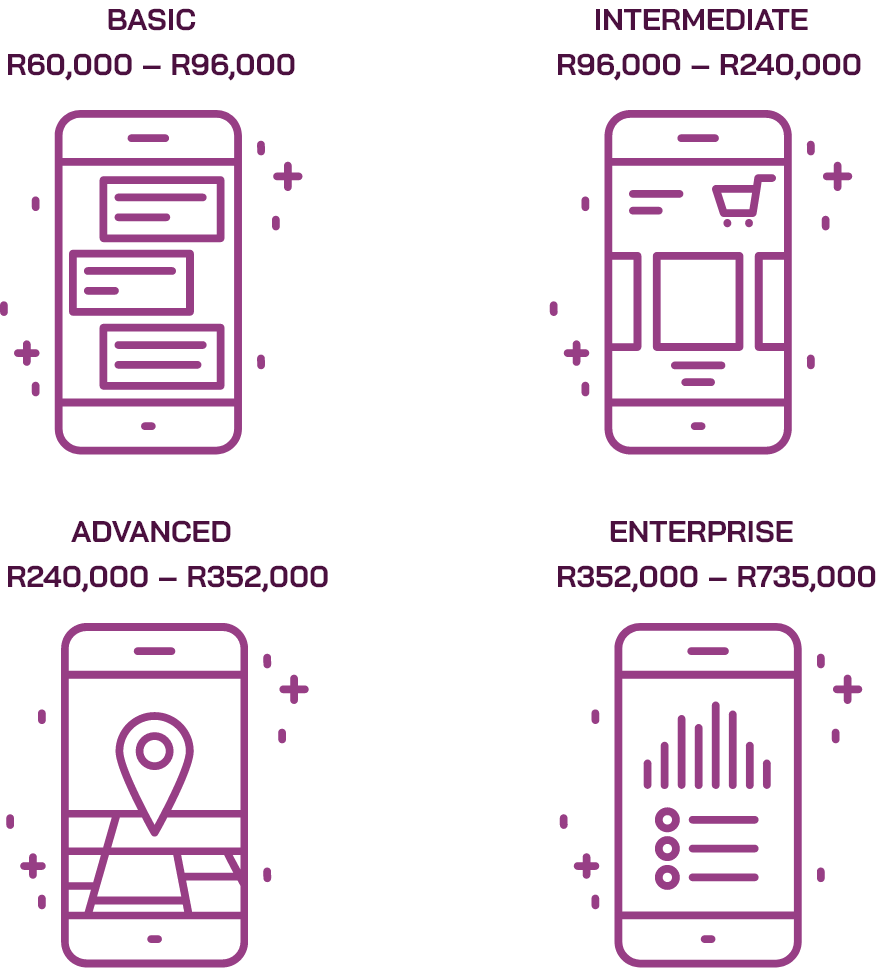
These ranges are THE FORMULA LAB’s 2026 build prices for once-off app development, excluding VAT:
| App type | Build cost (ZAR) | Typical timeline | Examples |
| Basic | R60,000 – R96,000 | 6 – 10 weeks | Business, restaurant menu, church or school information apps |
| Intermediate | R96,000 – R240,000 | 10 – 18 weeks | Booking, food ordering, online store and learning apps |
| Advanced | R240,000 – R352,000 | 4 – 7 months | Taxi, marketplace, delivery and healthcare apps |
| Enterprise | R352,000 – R735,000 | 7 – 14+ months | FinTech, SaaS, ERP and insurance platforms |
For a line-by-line breakdown of design, development, testing and deployment costs at each tier, see our full app development cost guide for South Africa.
Want to know which tier your app falls into?
Why App Development Costs Vary So Much
An app is not a product off a shelf. It is a set of features, screens, data and connections built for your business, and every one of those choices adds time.
Two apps can look identical on the surface and still differ by hundreds of thousands of rand. One might use a simple email login, while the other connects to your accounting system, takes card payments and tracks drivers in real time.
The price also depends on who builds it. A freelancer, an offshore team and a local app development company will each quote differently, and each includes different things in that number.
7 Factors That Drive the Cost of Building an App
Each factor below changes your app development cost. Knowing them helps you compare quotes and decide where to spend.
1. Features and Complexity
Features are the single biggest cost driver. User accounts, payments, chat, GPS tracking, bookings and push notifications all add design, development and testing time.
What it adds to your budget: The more features, roles and screens, the higher the tier. A single-purpose app stays Basic; a two-sided marketplace is Advanced.
2. Platforms: iOS, Android or Both
Building separate native apps for iOS and Android means two codebases. Cross-platform frameworks such as Flutter or React Native use one codebase for both, which usually costs less. A progressive web app can be cheaper still for the right use case.
What it adds to your budget: Two native apps cost the most. Cross-platform or a PWA can reduce build and maintenance costs. Our post on when to choose a PWA instead of a native app explains the trade-offs.
3. UI/UX Design
Good design is not decoration. It decides whether customers understand your app in seconds or delete it in minutes. Custom user research, wireframes and branded interfaces take time to get right.
What it adds to your budget: UI/UX design runs from about R10,000 for a basic app to R80,000 for an enterprise platform.
4. Backend, Admin Panel and Integrations
The backend is the part users never see: the database, server logic, admin dashboard and connections to other systems. It is usually the largest line on any app quote.
What it adds to your budget: Backend development ranges from R22,000 for a basic app to R400,000 for an enterprise platform. Each integration with payment gateways, CRMs or accounting systems adds more.
5. Security and POPIA Compliance
Any app that collects names, phone numbers, locations or payments processes personal information. In South Africa, that means it must comply with the Protection of Personal Information Act (POPIA).
What it adds to your budget: Secure authentication, encryption and privacy-by-design are built into a professional quote. An independent penetration test typically costs R10,000 to R40,000.
6. Testing and Quality Assurance
An app must work on dozens of phone models, screen sizes and network speeds. Testing finds the bugs before your customers do.
What it adds to your budget: Testing and QA range from about R5,000 for a basic app to R25,000 for an enterprise platform. Skipping it usually costs more in bad reviews and emergency fixes.
7. Who Builds It: Local, Offshore or Freelance
Offshore teams and freelancers can quote lower hourly rates. But time-zone gaps, communication delays and limited after-launch support often erase the saving. POPIA also restricts sending personal information outside South Africa without adequate protection.
What it adds to your budget: A local app development company may quote more than a freelancer, but includes project management, testing, deployment and accountability for the result.
Where the Money Goes in a Typical App Build
For an Intermediate app (R96,000 to R240,000), the budget typically splits like this:
- Backend development: R35,000 – R120,000 (the largest share)
- UI/UX design: R18,000 – R33,000
- API integrations: R5,000 – R25,000
- Frontend development: R15,000 – R20,000
- Project management: R7,000 – R15,000
- Discovery and planning: R4,000 – R12,000
- Testing and QA: R6,000 – R8,000
- App store deployment: R6,000 – R7,000
Discovery is the smallest line, but it protects every other one. A clear scope up front is what keeps the rest of the budget on track.
The Hidden Costs Most App Quotes Leave Out
The build is a once-off cost. Running the app is not. These are the ongoing app maintenance costs to plan for from day one:
- Apple Developer Program: about R1,800 per year to publish on the App Store
- Google Play registration: about R430, paid once
- Cloud hosting: R300 to R15,000+ per month, depending on users and data
- Maintenance and updates: R1,000 to R25,000 per month for OS updates, security patches and bug fixes
- Third-party services: maps, SMS (about R0.15 to R0.50 per message), payment gateways and analytics
- New features after launch: typically R15,000 to R80,000 per feature
- VAT: 15% on top of quoted prices for VAT-registered suppliers
A useful rule of thumb is to budget 15–20% of the initial build cost per year to keep your app secure, compatible and up to date. Apple and Google update their operating systems every year, and apps that are not maintained start to break.
Planning Your
App Budget?

How Long Does It Take to Build an App?
Timelines follow complexity. A Basic app takes about 6 to 10 weeks, an Intermediate app 10 to 18 weeks and an Advanced app 4 to 7 months. Enterprise platforms can take 7 to 14 months or more.
Time is cost. The fastest way to stay on schedule is to agree on the scope, designs and content before development starts, and to keep changes for a planned second phase.
Does AI Make App Development Cheaper?
It can, within limits. A 2026 GoodFirms survey of more than 100 software development companies found that 61% expect AI to reduce project budgets by 10–25%.
The saving comes from routine coding, documentation and testing. It does not remove the need for architecture, security reviews and accountability. Our post on the pitfalls of using AI when developing an app explains why AI-built apps without expert oversight often cost more to fix later.
How to Reduce App Development Costs Without Cutting Corners
A lower app development cost should come from smarter planning, not from skipping testing or security.
Start With an MVP
Launch a minimum viable product with only the features your first users need. Add the rest once real usage shows what matters.
Choose the Right Platform
If your users do not need advanced phone features, a cross-platform app or a PWA can serve iOS and Android from one codebase.
Invest in Discovery
A proper scoping session costs a fraction of the build and prevents expensive changes halfway through development.
Build in Phases
Split the project into fixed-scope phases with clear sign-offs. You control spending and can pause between phases.
Use Proven Components
Established payment gateways, login systems and admin frameworks are faster and safer than building everything from scratch.
Why the Cheapest App Quote Often Costs More
A low quote usually means something is missing: testing, security, documentation, app store deployment or support after launch. Those costs return later, often at a higher price.
Overruns are common even on professional projects. A McKinsey and University of Oxford study of more than 5,400 IT projects found that large projects ran 45% over budget on average, while delivering 56% less value than predicted.
The fix is not the cheapest quote. It is a clear scope, a fixed-price phase structure and an app development company that owns the outcome.
Comparing app quotes?
How to Get an Accurate App Development Quote
The more detail you share, the more accurate your quote. Before you speak to app developers, prepare:
- The problem the app solves and who will use it
- The main features and user roles (customers, staff, admins)
- Platforms: iOS, Android, web or all three
- Systems it must connect to, such as payments, accounting or a CRM
- Two or three apps you like, and what you like about them
- Your budget range and launch date
Then ask each app development company the same questions: What is included? Who owns the code? How are changes priced? What does support cost after launch? A typical payment schedule is a 30–40% deposit, then payments at design sign-off, development sign-off and launch.
Plan Your App Budget With an Experienced App Development Company
At THE FORMULA LAB, our mobile app developers in Cape Town build apps for businesses across South Africa. We quote by tier, explain every line item and separate the once-off build from monthly running costs, so there are no surprises.
Whether you need a native app, a progressive web app or bespoke software development, we help you choose the right scope for your budget and support your app long after launch. Based in Cape Town? See our app development costs for Cape Town.
An App Is an Investment, Not an Expense
The right app pays for itself through bookings, sales, saved admin time or better customer loyalty. Getting there depends on:
- A clear scope before development starts
- The right platform for your users
- A budget that includes running costs, not only the build
- Professional testing, security and POPIA compliance
- An app development company accountable for the result
Plan for all five and your app development cost becomes a predictable investment rather than an open-ended risk.
Ready to price your app?
Frequently Asked Questions About App Development Costs
How much does it cost to build an app in South Africa in 2026?
Building an app in South Africa costs between R60,000 and R735,000 in 2026, depending on complexity. Basic apps cost R60,000 to R96,000, Intermediate apps R96,000 to R240,000, Advanced apps R240,000 to R352,000 and Enterprise platforms R352,000 to R735,000. Hosting and maintenance are billed separately.
Why do app development quotes in South Africa differ so much?
Quotes differ because of features, platforms, integrations, design depth and what each supplier includes. Some quotes leave out testing, deployment, security or support after launch. Compare quotes line by line, not on the total alone.
What costs are not included in an app development quote?
Most build quotes exclude ongoing costs such as cloud hosting, maintenance, the Apple Developer Program fee, third-party services like SMS and maps, new features after launch and VAT. Ask for these to be listed separately.
How much does it cost to maintain an app per year?
Budget about 15–20% of the initial build cost per year for maintenance, updates and security patches. Monthly maintenance typically ranges from R1,000 to R25,000, with hosting from R300 to R15,000 or more.
Can I build an app for R50,000 in South Africa?
A fully custom native app for under R60,000 is unlikely from a professional app development company. A progressive web app, a simple MVP or a phased build can fit a smaller budget while leaving room to grow.
Is a cross-platform app cheaper than a native app?
Usually, yes. Cross-platform frameworks such as Flutter or React Native use one codebase for iOS and Android, which reduces build and maintenance costs. Native apps may still be the better choice for apps that rely heavily on device features.
Does AI make it cheaper to build an app?
AI can reduce some costs. A 2026 GoodFirms survey found 61% of software companies expect AI to cut project budgets by 10–25%. The saving only holds when experienced developers review, test and secure the AI-assisted code.
What is an MVP and how much does it cost?
An MVP (minimum viable product) is the simplest version of your app with only its core features. In South Africa, most MVPs fall within the Basic or Intermediate range of R60,000 to R240,000.
Should I choose a fixed-price or hourly quote for app development?
A fixed price per phase gives you budget certainty when the scope is clear. Hourly billing suits projects where the scope is still changing. Many businesses combine both: a paid discovery phase, then fixed-price development phases.